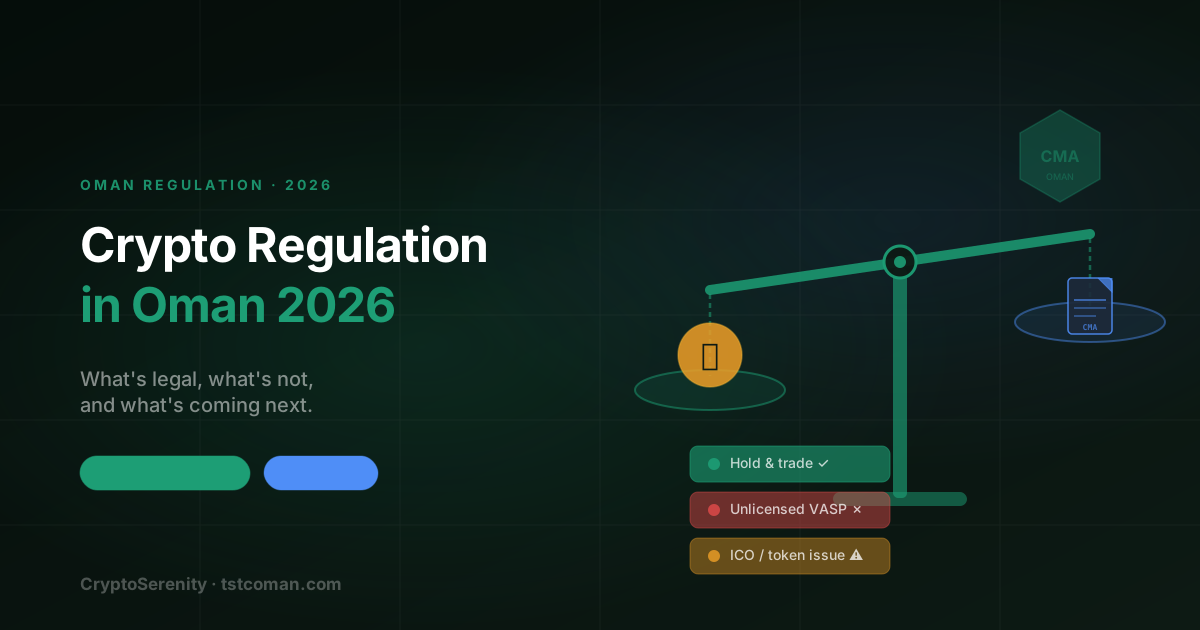
Crypto Regulation in Oman 2026: What's Legal, What's Not, and What's Coming
The CMA Virtual Assets framework, the Central Bank's position, business licensing, and how Oman compares to its GCC neighbours.
Oman's position on cryptocurrency has shifted dramatically in the last two years. From a country with informal advisory caution and no specific framework, it has moved to one of the more clearly regulated GCC jurisdictions following the Capital Market Authority's 2024 Virtual Assets framework. This article walks through what's now in place, what individuals and businesses can and can't do, and where the regulatory direction is heading.
The CMA Virtual Assets framework (2024–2026)
In July 2024, the Capital Market Authority (CMA) issued the Virtual Assets Regulation, establishing Oman's first formal regulatory framework for the crypto sector. Key elements:
- Licensed Virtual Asset Service Providers (VASPs). Anyone offering crypto exchange, custody, transfer, or token issuance services in Oman now needs a CMA licence.
- Defined virtual asset categories. The framework distinguishes payment tokens, utility tokens, asset-referenced tokens (stablecoins), and security tokens — each with different requirements.
- AML/CFT integration. VASPs must implement Anti-Money Laundering and Counter-Financing of Terrorism controls aligned with FATF standards.
- Consumer protection rules. Mandatory disclosures, suitability assessments for retail investors, and segregation of client assets.
- Sandbox provision. Innovative providers can apply for a regulatory sandbox to test products before full licensing.
Where the Central Bank of Oman stands
The Central Bank of Oman (CBO) regulates banks and payment systems — not virtual assets directly. The CBO has issued advisories (most recently reaffirmed in 2023) stating that:
- Cryptocurrencies are not legal tender in Oman.
- Banks should exercise enhanced due diligence on crypto-related transactions.
- Citizens should be aware of volatility and fraud risks.
Importantly, the CBO has not prohibited individuals from buying or holding cryptocurrency. The advisories function more as risk warnings than as bans. The 2024 CMA framework filled the regulatory gap that the CBO advisories left open — moving the conversation from "buyer beware" to "here are the licensed providers and the rules they follow."
What individuals can and can't do
Permitted (with appropriate due diligence)
- Buying, holding, and selling Bitcoin, Ethereum, and other established cryptocurrencies for personal account.
- Using international exchanges (Binance, Kraken, etc.) that perform KYC.
- Using GCC-licensed exchanges (Rain, BitOasis, CoinMENA) that accept Omani residents.
- Self-custody of cryptocurrency in personal wallets.
- Receiving cryptocurrency as payment for freelance work, with appropriate accounting for any tax position.
Restricted or unclear
- Operating an exchange or OTC desk in Oman without a CMA VASP licence.
- Issuing tokens (ICOs, IDOs, IEOs) targeted at Omani investors without regulatory approval.
- Offering custody services for clients commercially.
- Marketing high-risk derivatives (perpetual futures with high leverage) to retail Omani residents.
Always prohibited
- Money laundering or terrorism financing using cryptocurrency.
- Fraudulent token offerings or pyramid/Ponzi schemes.
- Sanctions evasion via cryptocurrency.
Business licensing: what's involved
For businesses planning to operate crypto services in Oman, the CMA VASP licence is now the gateway. The application process broadly involves:
- Incorporation. A locally registered company (typically an LLC or SAOG, depending on scale).
- Capital requirements. Minimum paid-up capital varies by service category — exchanges face higher thresholds than custody-only providers.
- Fit-and-proper test. Senior management and shareholders undergo background checks.
- Compliance framework. AML/CFT policies, custody arrangements, cybersecurity standards, and consumer protection procedures must be documented and approved.
- Ongoing reporting. Regular submissions to the CMA, including transaction monitoring and audited financial statements.
How Oman compares to GCC neighbours
UAE
The UAE leads the region with VARA (Virtual Assets Regulatory Authority, Dubai) and ADGM's framework in Abu Dhabi. Multiple licensed exchanges operate openly. Marketing rules are stricter, especially around retail derivatives. Oman's 2024 framework is conceptually similar but smaller in scale.
Bahrain
Bahrain's Central Bank issued crypto-asset rules in 2019, making it one of the earliest movers. Rain exchange operates under a CBB licence. Oman's framework arrived later but is comparable in substance.
Saudi Arabia
The Saudi Central Bank (SAMA) and Capital Market Authority have been more cautious. There's no formal retail crypto exchange licensing yet, though wholesale CBDC and DeFi pilots are progressing. Individuals can still buy crypto via international exchanges.
Kuwait
Kuwait's Central Bank issued a 2023 ban on cryptocurrency transactions, payments, investments, and mining. The strictest GCC stance. Oman's direction is the opposite: regulation rather than prohibition.
What's coming next
Three regulatory developments to watch over the next 18 months:
- Stablecoin specific rules. Most major jurisdictions are introducing dedicated frameworks for asset-referenced tokens. Expect Oman to do the same, particularly around USD-pegged stablecoins given the OMR's peg to the dollar.
- Tax clarification. Oman's introduction of personal income tax (announced for 2028) will likely come with crypto-specific guidance. Even if implementation slips, businesses should plan for it.
- CBDC integration. The Central Bank of Oman is exploring a digital rial. If launched, it will sit alongside — not replace — private cryptocurrencies, but will reshape on-ramps and off-ramps.
Bottom line
As of 2026, Oman has a real regulatory framework for crypto — not a ban, not a free-for-all. Individuals can buy and hold cryptocurrency on regulated international and GCC exchanges with clear KYC. Businesses operating crypto services need a CMA VASP licence. The direction is normalisation, with stablecoin and tax rules likely to fill in over the coming years.
Practical next steps: if you're a buyer, see our guide to buying Bitcoin in Oman. If you're holding, see our recommended wallets and tools. If you're a business owner exploring this space, the CMA Virtual Assets framework documentation is the authoritative starting point.
Educational purposes only. This is not legal, financial, or tax advice. Verify the current regulatory position with the CMA and Central Bank of Oman before making business decisions. Regulations evolve — always check the latest official guidance.