Wave Trading: How Elliott Waves Actually Work in Crypto
A practical breakdown of wave theory — what it predicts, what it doesn't, and how quants use it without the mysticism.
Wave trading has a reputation problem. Open any forum and you'll find a charlatan promising to call the top of Bitcoin to the top dollar using "Wave 5 of the Supercycle." Open any quant desk and you'll find no mention of Elliott Waves at all. The truth sits in the middle: the underlying observation — that markets move in alternating impulse and correction phases — is genuinely useful. The baroque labeling system wrapped around it is mostly folklore.
This article strips wave theory down to what actually trades. We'll cover the 5-3 structure, the Fibonacci ratios that aren't magic but aren't random either, how to spot waves without fooling yourself, and how algorithmic strategies encode these ideas without ever using the word "Elliott."
The core observation
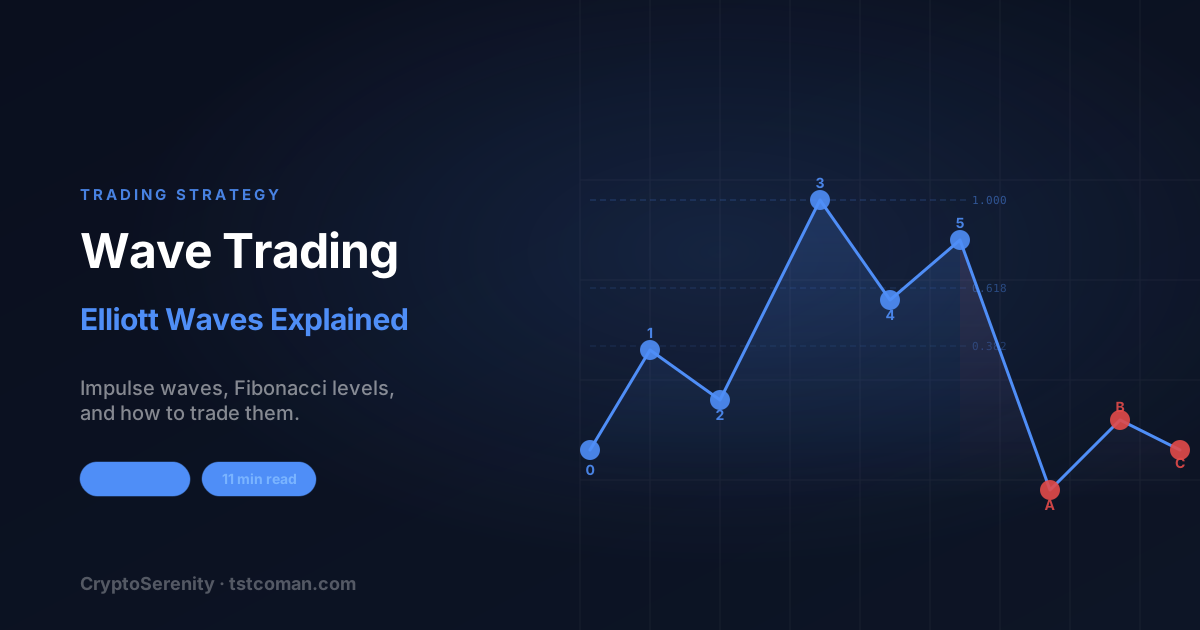
Price doesn't move in straight lines. It moves in pushes and pullbacks. Ralph Nelson Elliott catalogued this in the 1930s by looking at decades of Dow Jones data and noticed a repeating shape: a trending move unfolds in five sub-moves (three in the direction of the trend, two against), followed by a correction in three sub-moves.
That's it. Five up, three down. In a bull trend the pattern looks like: impulse 1 → correction 2 → impulse 3 → correction 4 → impulse 5 → correction A → bounce B → correction C. In a bear trend it inverts. Everything else in "Elliott Wave Theory" is scaffolding on top of this one observation.
The three rules that actually matter
Most wave theory is subjective. Three rules aren't:
- Wave 2 never retraces 100% of wave 1. If it does, you weren't looking at a wave 1.
- Wave 3 is never the shortest of the three impulse waves. Usually it's the longest.
- Wave 4 does not overlap wave 1. The low of wave 4 stays above the high of wave 1 in an uptrend.
Break any of these and your count is wrong. These three rules are the only parts of wave theory that survive backtesting — which is why algorithmic implementations lean on them and ignore the rest.
The Fibonacci piece
Wave retracements tend to cluster around specific ratios: 38.2%, 50%, 61.8%, and sometimes 78.6%. Wave extensions cluster around 161.8% and 261.8%. These ratios come from the Fibonacci sequence, and you'll see them in everything from sunflower spirals to nautilus shells.
Do they appear because of golden-ratio mysticism? No. They appear because everybody uses them. When thousands of traders draw their Fibonacci retracement tools at the same levels, those levels become self-fulfilling support and resistance. A 61.8% retracement isn't magic — it's a coordinated expectation.
Applying this to crypto specifically
Crypto is a good laboratory for wave analysis for three reasons: it trades 24/7 (no gaps), it's dominated by retail (so behavioral patterns are amplified), and the cycles are shorter than traditional markets (a full Bitcoin bull/bear cycle takes roughly four years, compressed enough to study multiple iterations in a lifetime).
Where BTC wave analysis has worked
Historically the cleanest Elliott counts in crypto appear at major cycle tops and bottoms. The 2017 top, the 2019 bottom, and the 2021 top all produced textbook 5-wave moves in retrospect. Wave 3 of each bull cycle has been the longest and steepest — consistent with rule #2.
That "in retrospect" qualifier matters. Real-time wave counts are ambiguous; retrospective wave counts always look obvious. The honest version of wave analysis treats it as a framework for describing what has happened, with the count only firming up after structural rules are confirmed.
Where it falls apart
Intraday and sub-daily charts are too noisy for reliable counting. Altcoin charts often lack the liquidity to produce clean wave structures. And any chart dominated by a single whale or a news event will show step-functions, not impulse-correction sequences. If you can't label waves 1-2-3 without torturing the data, you shouldn't be labeling them at all.
How algorithms actually use this
No professional quant desk runs an "Elliott Wave bot." What they do run is strategies that encode the same underlying observations — without the naming convention:
Trend-continuation on pullbacks
The idea behind buying wave 2 in an uptrend becomes: after a strong trending move (momentum filter), wait for a 38.2–61.8% retracement to a moving average, then buy on momentum re-acceleration. This is trend-following with a mean-reversion entry — the most robust setup in systematic trading, and it's essentially automating wave 3 entries without calling them that.
Exhaustion shorts
The idea behind shorting wave 5 becomes: detect divergence between price and momentum (price makes a higher high, RSI makes a lower high) after an extended trending move, then fade the move. Wave 5 divergence is the most backtested exhaustion signal in crypto.
Volatility contractions
Wave 4 corrections in Elliott theory are usually sideways and choppy — Bollinger Band squeezes captures the same observation without the labeling. A tight consolidation after an impulse is the setup; the breakout is the trade.
A minimal wave checklist you can trade
If you want to use wave concepts without the cult, here's a stripped-down version that fits on an index card:
- Identify the last clear trending move (use a 50 or 200 moving average for context).
- Draw a Fibonacci retracement from the start to the end of that move.
- Wait for price to pull back to the 38.2–61.8% band.
- Require confirmation: momentum turning back up (RSI > 50 after dipping, MACD crossing).
- Stop just beyond the 78.6% retracement. If it hits, your count was wrong.
- Target the previous high plus 61.8% extension — not "wave 5 terminal point."
What wave trading cannot do
It cannot predict when. It can only describe shape. The most disciplined wave analysts in the world don't say "Bitcoin will top at $120K on May 15" — they say "if this is wave 3, the structure completes between X and Y with these invalidation points." Anyone giving you dated price targets from a wave count is selling you certainty that the method cannot produce.
Wave analysis also does not tell you position size, risk limits, or when to stop trading. These are the parts that actually determine survival. A wave count with no risk management is just a horoscope.
Bottom line
Wave trading is not mystical and not useless. It's a descriptive framework for the fact that markets move in pushes and pullbacks, and that retracements cluster around common Fibonacci ratios because everyone is watching them. The three structural rules (no 100% retracement of wave 1, wave 3 isn't shortest, wave 4 doesn't overlap wave 1) are genuine constraints. Everything else — the cosmic numerology, the decades-long supercycle calls — is narrative.
Use the shape. Ignore the folklore. Size every trade by risk. That's the job.
Educational purposes only. Nothing in this article is financial advice. Past market behavior does not guarantee future behavior.